
The Montane Lakeland 100: None Shall Sleep
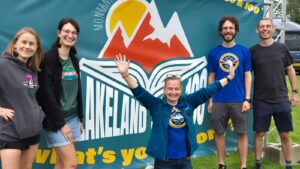
Gang at Coniston
Friday 25 July 2025, 18:00 – 19:34
Coniston to Seathwaite (0–7 miles)
3 minutes ahead of schedule
As I stood on the start line of the Montane Lakeland 100, I could feel the adrenaline surging through me. A mixture of excitement, hope, and fear enveloped the 721 competitors, all eager to get moving. As “Nessun Dorma” began to play, I took deep steadying breaths and closed my eyes to calm myself. Puccini’s operatic classic was the race start anthem, and its title – “None Shall Sleep” – could not have been more fitting.
It had been seven years since my last attempt, and I was determined to better my 32-hour finish. I wanted, more than anything, to go sub-30, and had drawn up an “optimistic best-case-scenario” race plan. I was older, but I had trained harder, and the forecast looked kind. But ultras are unpredictable, full of moving parts and unknown obstacles. Something unexpected would undoubtedly occur.
This year I had the pleasure of sharing the start with my husband Mark and our friends Marta and Giuseppe. We shuffled forward to get into position, arms linked to avoid being separated. We set off from Coniston in good spirits, supported warmly by our friends Simon, Elaine, and Kep – their labradoodle.
We moved quickly, determined to beat the bottleneck that forms as the path moved from road to fell. Mark and Giuseppe were already well ahead, but I managed to get through largely unhindered and now hiked steadily up towards Walna Scar.
As the trail grew steep, I reached for my poles. But as I pulled the cord taut to assemble them, one fell apart in my hands. I was less than three miles in, and I knew I’d be running without them. I didn’t panic – they weren’t essential (or so I thought), just handy. I ploughed on and reached Seathwaite checkpoint on schedule.
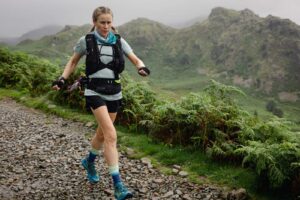
Leg 1 Coniston to Seathwaite
Friday 25 July, 19:34 – 21:16
Seathwaite to Boot (7–14 miles)
4 minutes ahead of schedule
Leg 2 is one of my least favourite sections. The elevation gain is manageable, but the boggy terrain and technical descents make it a real slog. At first I tried to avoid getting my feet wet, fearing the trench foot that afflicted me in 2018, but it quickly became clear that there was no dry ground, and I soon found myself ankle-deep in mud. The river crossings and rocky descents were slippery and I took them steadily to avoid mishap. (One runner, bafflingly, chose that moment to start vaping, much to my astonishment!) I made it to Boot checkpoint unscathed and prepared my headtorch for the night to come.
Friday 25 July, 21:16 – 22:40
Boot to Wasdale Head (14–19.4 miles)
4 minutes ahead of schedule
The sun set on the path to Wasdale. I switched my headtorch on at Burnmoor Tarn and turned to see the long chain of lights dotted along the winding path behind me. I might have been in the mountains in the middle of the night, but I was far from alone.
Reaching Wasdale always feels like an achievement. It’s a stunningly beautiful but remote valley, and even getting there by car is a mission! As I crossed the stone bridge to the barn that houses the checkpoint, I was greeted by “beer man” and a whole host of other superhero marshals, all bending over backwards to care for us! I gratefully grabbed some soup and sandwiches and waved happily to the live camera, to any friends and family watching from afar. I was ahead of schedule and I felt on top of the world!
Friday 25 to Saturday 26 July, 22:40 – 01:07
Wasdale to Buttermere (19.4–26.3 miles)
3 minutes ahead of schedule
With my flasks replenished, and a cup of tea in my hand, I set out into the night, ready to tackle Black Sail Pass, the longest and steepest climb yet.
The water at Gatherstone Beck was high, but my feet were already wet, so I waded through rather than attempting to balance on the slippery stepping stones.
As I pushed on uphill, I passed a runner hunched at the side of the path, vomiting. He said he was okay, but I knew his race was now in jeopardy. Gastrointestinal problems (nausea, vomiting, and diarrhoea) account for 30% of all DNFs.
GI distress had been my biggest concern going into the race, following an uncomfortable episode in April along the West Highland Way. Over the last few weeks, I revised my fuelling plan to exclude the energy powder that had previously worked so well for me. It took me the best part of three months to identify it as the likely cause. As a thirsty runner, drinking on average 500–750ml per hour, I had been consuming too much too quickly. My gut couldn’t cope, and the side effects lingered for weeks, causing great anxiety.
Now I stuck to water, with the occasional salt tablet for electrolytes. I found it easier to control my consumption of solid food. It was a simpler approach, proving that sometimes the old methods are best.
The descent from Black Sail Pass to Ennerdale Valley is one of the most technical sections of the course. I always dread it – the rocky terrain becomes treacherously slidey when wet. I knew I’d lose ground here, but getting down safely was all that mattered, so I allocated myself plenty of time to take it slowly.
When we reached Black Sail Bothy (the most remote YHA in England) the guests were bathed in lamplight, drinking beers and partying merrily. I’ve always wanted to stay there. It looked so inviting, and I regretted not being able to join them!
The climb up Scarth Gap and descent into Buttermere passed steadily, and I arrived at the checkpoint on schedule. I removed my shoes and muddy socks. The balls of my feet were pale and wrinkly like prunes, but otherwise okay. I gave them a wipe and reapplied the trench foot cream that Simon had recommended a few weeks prior. My fresh clean socks were an amazing boost!
Saturday 26 July, 01:07 – 03:06
Buttermere to Braithwaite (26.3–32.8 miles)
9 minutes ahead of schedule
After eating a veggie dog, I set off again, cup of tea in hand. As I entered Ghyll wood, I took care to avoid the wrong turn Marta and I had taken a few weeks prior on our recce. A group of runners behind me veered off course but quickly righted themselves to follow me.
Not long after, I was joined by Matthew from Colne. We’d buddied up previously near Boot and discovered we were birthday twins: born two days apart. We chatted away as we climbed the steep scree trail over Sail Pass, but I lost him on the technical descent. Still, I arrived at Braithwaite before him, as he’d taken a wrong turn through the heather with a group of other runners. It was the same wrong turn I took in 2018, but which I knew to avoid this year!
Saturday 26 July, 03:06 – 05:15
Braithwaite to Blencathra (32.8–41.3 miles)
10 minutes ahead of schedule
At Braithwaite, I refuelled on soup, pasta, and sandwiches. I set off again with a cup of hot tea, walking and sipping before easing into a steady trot. These few miles along the A66 to Keswick were the longest stretch of tarmac and, after 8,500 ft of climbing, a welcome relief. The most challenging part of the course was now behind us.
As I made the climb up Spooney Green Lane, I could see the faint glow of headtorches twinkling in the distance between Sail Pass and Braithwaite. They were only five miles behind, but already that part of my journey felt like a distant memory.
When daylight broke at Glenderaterra, I switched off my headtorch. The first night was over. I should have felt rejuvenated by the sunrise, but instead, I was growing ever more conscious of the tendinitis in my right shin. I knew I’d need to make a decision soon about whether I could continue.
The first time I realised my shin was going to be a problem was between Seathwaite and Boot. It had started with a tightness on the top of my foot, under my laces. It was the same sensation I’d felt three weeks earlier, on my last long training run from Coniston to Buttermere. That recce ended in disaster: a slow, painful hobble followed by five days of forced rest.
I reacted quickly, loosening my laces again and again, and eventually removing them from the top eyelet altogether. I tried not to panic and focused on finding a solution. I set about trying to locate some wool to place between my foot and shoe to relieve the pressure – a trick I’d remembered from the legendary fell runner Joss Naylor. You’d think it would be easy to locate wool in a sheep field, but all I found were a few damp strands.
I took out my phone, thinking I might call Simon, our friend and one-man support band. He’d said he could collect anyone from Braithwaite onwards, but it didn’t occur to me that it was only five in the morning! Elaine would still be sleeping, and an abrupt awakening before her own race would be the last thing she needed.
Luckily, before I could call, I spotted a voice message from our friend Raissa, offering her support and encouragement. It was exactly what I needed, and soon put an end to my doubts.
I started to think logically. I was hitting my target schedule perfectly, and as long as I could put one foot in front of another, I had no excuse not to continue. I plotted the route ahead of me. The next few checkpoints to Dalemain were reasonably flat. I would move tentatively on the downhills and push the climbs. I would go from checkpoint to checkpoint and reassess when needed. But I couldn’t quit now when things were going so well.
Saturday 26 July, 05:15 – 07:21
Blencathra to Dockray (41.3–50 miles)
4 minutes ahead of schedule
At Blencathra checkpoint, I took my first two paracetamol and rubbed Deep Heat on my shin. I doubted it would help, but it was all the first aiders had. What I really needed was the ibuprofen gel I’d left in my drop bag – another twenty miles away in Dalemain! So I grabbed some toast for breakfast and set out on my way.
Leaving Blencathra, I met George, a 21-year-old runner who was wise beyond his years. He was so relaxed and positive, it was infectious. We chatted for a while before I said goodbye and pushed on, buoyed by his enthusiasm.
The next few miles passed swiftly as I made my way up to the Coach Road. I was relieved that the clegs that had feasted on Marta and me two weeks earlier were nowhere to be seen. I’d been bitten around twenty times in as many minutes, and the welts were still visible on my legs. This time, I’d armed myself with Smidge, but thankfully it wasn’t needed.
By now, the trail had thinned out, and I’d been running alone for several miles. I didn’t regret the solitude. I’d run most of my long training runs alone, and it had given me the headspace to appreciate my surroundings. I felt incredibly fortunate to be on this journey, and grateful that my body was able to do this.
Saturday 26 July, 07:21 – 09:38
Dockray to Dalemain (50–59.1 miles)
17 minutes ahead of schedule
Dockray checkpoint had grown legs. Instead of being in the car park at the end of the Coach Road, it had moved a mile further, into the village itself, causing much consternation among the bewildered runners.
When I eventually arrived, I was greeted warmly by Moira, a volunteer from Lincolnshire who knew Mark from the shop. Mark had passed through an hour previously and was doing well. I was grateful that she’d taken the time to look out for me, and I thanked her for her support.
Inside the checkpoint, I was also surprised to see Giuseppe! I hadn’t expected to see him again until Coniston, and was disappointed to hear that he had retired from the race. He’d been close to blacking out, with what we later discovered was Covid.
Giuseppe described how he and Mark had run together, and how Mark had stuck with him when he began to feel unwell. But then Mark himself had started to struggle and stayed behind at Braithwaite. He’d almost dropped out but managed to get moving again and was still on track to break 30 hours.
I knew Mark wouldn’t be happy with that prospect. He’d set out to break 24 hours, and the road ahead would be tough, both physically and mentally. I wanted to call him, but I knew he wouldn’t answer. He would be grinding it out with everything he had. If he slowed again, it was possible I might catch him, and I wondered if we could finish this together!
I hugged Giuseppe goodbye. I was now running for both of us, and was determined to finish for him too!
I jogged on to Aira Force and joined the Ullswater Way, one of the most scenic sections of the course. The trail was neither too steep nor technical and included a few miles of road, making it relatively swift and runnable.
I took it comfortably, preserving my shin, and soon found myself turning onto the familiar path of the Dalemain Estate. It was here, in 2015, that I ran the Marmalade 10k – one of my first proper trail races! Back then, I didn’t even know that ultras existed! Little did I know that life was about to change. When I met Mark in 2015, he was already preparing for his first Lakeland 50, which broadened my understanding of what was humanly possible.
As I reached Dalemain mansion, the cheer of the crowd was deafening. The Lakeland 50 runners were assembling at the start line, and the air was full of nervous energy and excitement. I knew Elaine would be in that crowd, her belly full of butterflies in anticipation for the race ahead. I was looking forward to seeing her on the trail, as she zoomed past me.
Saturday 26 July, 09:38 – 11:48
Dalemain to Howtown (59.1–66.2 miles)
7 minutes ahead of schedule
As I entered the checkpoint, a volunteer passed me my drop bag. It was full of all the stuff I thought I could possibly need! I had scheduled myself a twenty-minute break, and followed the instructions I prepared to avoid any unnecessary thinking. I didn’t know what frame of mind I’d be in, and didn’t want to forget anything vital. I followed my list diligently:
- Charge watch ✔️
- Remove shoes & socks ✔️
- Clean & dry feet ✔️
- Treat blisters ❌
- Remove and replace wet clothing✔️
- Eat!!✔️
- Wash face & apply sun cream ✔️
- Reapply anti-chafe and trench foot✔️
- Brush teeth ❌
- Discard rubbish ✔️
- Replenish race nutrition✔️
- Refill flasks ✔️
- Replenish medical supplies✔️
- Put on new shoes ✔️
I also applied ibuprofen gel to my shin, took another two paracetamol, and ditched the broken poles I’d carried for nearly 60 miles. In the background, I could hear the loud clap of “Thunderstruck” by AC/DC. The Lakeland 50 was underway.
As I left the marquee, I heard someone shout my name. I looked up and was excited to see Simon, Giuseppe and Kep! They’d seen off Elaine, who was “nervous as hell” and had dashed over to the marquee in an attempt to intercept me before I left. Unfortunately, Giuseppe was still feeling unwell, but Simon power-walked with me for a short while as we chatted. I told him about my shin, but said I was continuing on for as long as I could. I couldn’t stop yet – I was still on track!
We went our separate ways, and I trotted on to Pooley Bridge, spurred on by the support of spectators. I was smiling from ear to ear and feeling great. I didn’t know how long it would last, but I was having the time of my life.
On the climb to Roe Head Farm, the first Lakeland 50 runners started to pass me. They were sprinting effortlessly uphill, greeting me and encouraging me along the way. Their energy gave me a boost, and I moved to the side to let them thunder past. It temporarily distracted me from the hot spots I could feel forming underfoot.
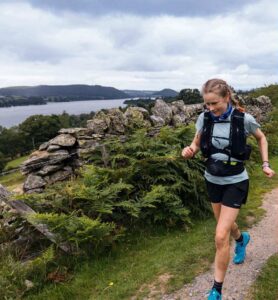
Simone on her way to Howtown
Saturday 26 July, 11:48 – 15:02
Howtown to Mardale (66.2–75.6 miles)
7 minutes behind schedule
At Howtown, I removed my shoes to examine my feet. Two red blisters were beginning to form on my right foot, and a kind medic helped me to attach some Compeed plasters. My unplanned stop had lost me precious time, but ignoring the issue could have cost me dearly later, so it was worth the effort.
I filled up my flasks and grabbed a bag of salted boiled potatoes to go. They were delicious, and I wished I’d taken more! There would not be another checkpoint for around three hours, and I would desperately need the energy.
Leaving Howtown, I was overjoyed to see Elaine. We’d recced this stretch together in June, so it was fitting that our paths should cross here. Her legs were fresh and eager, and I couldn’t keep up with her for long. We said our goodbyes and wished each other well, not knowing that the path was about to get so much tougher for both of us!
Up ahead was Fusedale, the highest point of the course, and a never-ending beast! I’d hiked it many times in all manner of weather, including a hailstorm back during my 2018 race. That year, the weather had been torrential, and I had grown so cold on the climb that I found myself breaking into a sprint at the top in order to generate some body heat! The climb today was muggy and sapping, but I dug in and didn’t lose too much time.
The muddy, slippery descent, followed by the endless four-mile slog around Haweswater, was the first time I felt my spirits sink. I had loved every moment of the race until now, but the slow and rocky terrain, coupled with the ever-increasing pain in my shin, meant that doubt was starting to creep in.
Saturday 26 July, 15:02 – 18:02
Mardale to Kentmere (75.6–82.1 miles)
1 hour and 7 minutes behind schedule
When I finally reached Mardale, I sought out a medic. I knew I needed pain relief, but I couldn’t calculate how much more paracetamol I’d be allowed to take. Time was now a blur, and brain fog had started to set in. I didn’t want to get it wrong and accidentally poison myself! Happily, I could take another two tablets, though they barely made a dent.
I often think of Mardale as the valley of broken dreams. Too many Lakeland races end in this isolated place with a DNF. In 2018, I’d felt some pressure to retire here after seeing the many shattered runners huddled under the marquee, shivering as a thunderstorm raged in the sky above.
There had once been a village here, but it had been abandoned in the 1930s when the Manchester Water Company cleared the area to make way for the reservoir. Even the graveyard had been dug up and relocated. Whenever I pass through, I cannot help but think of the lonely souls who were forcibly removed, and a spine-tingling wave of sadness surges through me.
I didn’t want to linger here too long, so I made my way up Gatesgarth with sandwiches and tea in hand. As soon as I hit the summit, I knew I was in trouble. Flexing my foot to descend was excruciatingly sore. I called Simon and told him of my predicament. We both knew I had to continue to Kentmere. There was no “out” on the top of Gatesgarth.
So I made my way, walking the descents and hobbling along the flats. I tried to modify my running form, to take the pressure off my shin, but this meant I was moving awkwardly and overloading my left quad and calf.
I was now being passed by hundreds of 50 milers, each shouting my name, from the bib on my backpack. I tried to thank them all, but the energy required was slowly evaporating, as I withdrew into myself. Many still stopped to check how I was doing, and one kind soul even gave me some electrolytes from their supplies. I tried to stay positive for as long as I could, but I was slowly crumbling.
I’ve always thought of this race as a lifetime condensed into a single day, with all the emotions amplified. It’s an emotional rollercoaster: when you are high, you are so high. Between Gatesgarth and Kentmere, I was at my lowest of lows, full of self-doubt and sadness.
Saturday 26 July, 18:02 – 21:10
Kentmere to Ambleside (82.1–89.4 miles)
2 hours and 15 minutes behind schedule
I arrived in Kentmere ready to quit the race and asked a marshal how long it would be before the sweeper bus arrived.“Forty-five minutes,” she replied, “but it won’t leave until it’s full, so it might be midnight.” At 6pm, that was far from ideal!
So I called Simon and asked him what I should do. He couldn’t collect me for at least another two hours and suggested that I keep going to Ambleside, where he was waiting for Elaine. There was no option then, I had to continue.
As I set off, I started chuckling to myself. I’d just been conned into finishing. I knew that if I made it to Ambleside (90 miles) I wouldn’t give up. My target time might be in tatters, but I was still well ahead of the cut-offs. I could walk the last 15 miles, even if it took me 10 hours.
On the descent to Troutbeck, I caught sight of Lake Windermere. It filled me with warmth, the way it always does. Ambleside was not far now, and it felt like I was going home.
In Troutbeck, I was overtaken by George! He was still moving, still cheerful and commented jokingly, “If I was tendinitis, I would be terrified of you!” He was right. I’d been dealing with this now for over 12 hours. He lifted my spirits, and though I couldn’t keep up, this encounter helped me more than I could express.
Saturday 26 July, 21:10 – 23:51
Ambleside to Chapel Stile (89.4–95 miles)
3 hours and 6 minutes behind schedule
Arriving at Ambleside, I was greeted by a host of incredible volunteers, who took wonderful care of me. I was guided into the parish hall by a medic, who examined my shin and allowed me to apply one last dab of ibuprofen gel. It was now starting to get dark, and she supervised as I changed the battery of my headtorch. I didn’t want any nasty surprises on the top of Tilberthwaite!
I was then ushered into a makeshift canteen, where I picked up another peanut butter and jam sandwich and a cup of hot tea. Quite a few runners were sitting around, reluctant to leave, and a passing marshal accused them of becoming “far too comfortable” and told them “to get a move on.” It made me chuckle, and I waved to George (who was amongst them) and made my way outside.
I then saw Simon, who had been patiently waiting for me to leave. He must have been there for hours, having seen Mark through at 6pm, Elaine at 7pm, and now me! I’d have dropped out hours ago if it weren’t for his support! I thanked him for his encouragement and told him I was pushing on. I would walk the last 15 miles, even if it took me all night. I hugged him goodbye, switched on my headtorch, and made my way.
As I climbed the path towards Loughrigg, I glanced out towards the fell. Though I wouldn’t be climbing the summit today, I couldn’t help but smile to see the place Mark had proposed in 2018. Our wedding took place on the second of August, five days after my first Lakeland 100. I had recovered quickly and even managed to squeeze my feet into heels!
Shortly after, I met Sarah Lowe. Sarah was aiming for her first completion, after retiring at Howtown last year. She was struggling with an injured knee, and we started “hobble-walking” together. Determined for us both to finish, she took care of me from that point on – taping my shin, sharing her supplies, and sticking with me even though she could have pushed on and saved herself hours. I owe her such a debt of gratitude. Without her by my side, there is no way I could have completed this.
As the second night came down and fatigue set in, the path to Chapel Stile felt endless. It is one of the most runnable sections of the course, and anyone who was still capable could make good time here. George reappeared and pressed on, and so did Matthew from Colne. He said he was done, and that he had nothing left in his legs, but he sprinted on, never to be seen again. My perception of speed was entirely altered. Anyone moving faster than me seemed to be hurtling by at a rapid rate.
Eventually we reached Chapel Stile. The volunteers worked tirelessly, making sure we were okay, bringing us food and a blanket to keep me warm. I was cold, from moving so slowly, but more than anything, I probably needed to refuel. When my legs stopped working, my brain gradually followed suit, and I became less diligent with my nutrition. After a cup of hot tea and a bowl of vegetable stew, I began to rally. Sarah was ready to leave and I had no idea how I’d finish without her, so I pulled myself together determined to do this once and for all.
Saturday 26 July – Sunday 27 July, 23:51 – 03:51
Chapel Stile to Tilberthwaite (95–101.5 miles)
5 hours 21 minutes behind schedule
The next few miles between Chapel Stile and Tilberthwaite are a bit of a hazy blur. In the Langdale Valley, we were joined by a group of runners playing quizzes to stay awake and pass the time. In one round, we had to match songs to our situation. I didn’t have the brainpower to contribute but I enjoyed listening, and appreciated the humorous interjections. “500 miles”, “Running up that Hill” and “I will survive” were among my favourites! I will always be grateful to those anonymous runners for their playful banter in the dark!
When we reached Blea Moss, Sarah lent me one of her poles for balance, to help lever myself over the rocky, technical trail. It’s not my favourite stretch, and on this day it was particularly challenging. I moved carefully, keeping to the high ground to avoid the “bog of eternal stench,” before we hit the road at Wrynose Pass. I was glad to be back on the tarmac, though I couldn’t make the most of it. We plodded on towards Tilberthwaite, noting the headtorches in the distance on the final climb.
Sunday 27 July, 03:51 – 06:24
Tilberthwaite to Coniston (101.5–105 miles)
6 hours 25 minutes behind schedule
Arriving at Tilberthwaite, I felt a mixture of relief, joy, and sadness. Our adventure was nearly over, but these memories would last a lifetime. We sat down in the deck chairs around a roaring fire pit, and helped ourselves to the toasted cheese sandwiches the volunteers were cooking. They were grilled to perfection and tasted absolutely delicious.
As we set off up Jacob’s Ladder for the last climb, I knew it would be a mammoth struggle. My left quad, which had been working hard to compensate for my right shin, was done. I levered myself up the rocks with Sarah’s pole, knowing she had truly saved the day. Without her support, there would be no finish. She waited every time I fell behind, refusing to leave and giving up a faster time to ensure I finished.
Dawn broke as we began to descend. My shin screamed with each step, and I resorted to a slow bum-crawl over the steep, craggy rocks. Observing this, another kind runner took pity on me and offered up his poles! I protested, but he said he wasn’t using them, and pulled them from his bag. I didn’t catch his name, but made a mental note of his number – 810 – as he skipped past me and returned Sarah’s second Leki.
When we reached the tarmac descent into Coniston, I was relieved beyond belief. Though we were unable to run this final stretch, it didn’t dampen our spirits, and we hobbled on towards the town.
We were being overtaken by a steady trickle of finishers, as they made their way to finish at John Ruskin School. One of these runners was Jackie Stretton, who had run the 100 in 2018 and every year since. We’d run together a little that year and had met several times at subsequent events. I cheered her on as she flew past me, for a stunning 10th finish!
As we passed the Black Bull pub and turned onto Yewdale Road, I noticed how quiet the village was. It was early Sunday morning, and most people were still fast asleep. A few spectators were milling around, silently supporting their runners, doing their best not to disturb the local residents.
As we turned onto Lake Road, the finish line came into view. Sarah and I linked arms and crossed together at 6.24 am on Sunday 27th of July! We’d done it!
The End
As we were guided through the finish funnel by a marshal, I caught sight of runner 810. He’d finished 20 minutes earlier and had been waiting for our return. I thanked him for his help, and gratefully returned his poles.
As we waited to be announced into the race marquee, Sarah jumped up and down, waving excitedly to friends. Up ahead I spotted Mark, Giuseppe, and Marta, and burst into tears, overjoyed. After their own adventures, I’d expected them to be fast asleep, but Giuseppe had been keeping an eye on the clock, setting and then resetting his alarm as I inched my way to the finish. He hadn’t expected my final three miles to take two hours, and they’d been there since 4.30am!
The marshal took Sarah and me by the arm, and we hobbled into the tent, “We’ve got Sarah and Simone who’ve done the 100!” she shouted, and a wave of applause erupted. Mark and I shared the biggest hug (captured for posterity in the official Lakeland film) and I told him how Sarah – the true legend of this tale – had saved the day.
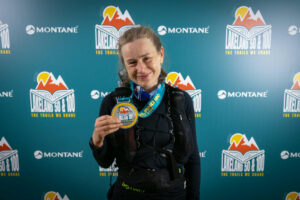
Simone at the Finish!
Three Weeks Later
Three weeks have passed since I ran the Lakeland, and I’m still processing the way I feel about my race.
I feel an overwhelming sense of gratitude, to all those that helped me along the way. To my friends (near and far), fellow competitors, volunteers, first aiders and everyone who contributed to my finish. This was for you.
It was easy when things were going well. But it wasn’t toughness that got me through, it was the determination of those around me. You encouraged and supported me through my training and through my race and wouldn’t let me give up.
I had never planned to run through injury, but it felt harder to stop than to continue. I feel a newfound respect for those who grind it out, and through sheer will and determination continue through the pain.
Am I bothered that I didn’t hit my target time? A little bit. But I learned so much more about myself than if everything went smoothly.
Looking back, I don’t think there was much I could have changed. So much went right, and so much was beyond my control.
If I had stopped, I would have regretted it. If not immediately, then certainly over time. It would have ground away at me, knocked my confidence. I don’t like leaving anything undone.
Still, I feel like I have some unfinished business. I didn’t achieve what I set out to do, and so I must go again. Not with the Lakeland, it’s time to let this race go. Every time I try to repeat an ultra it is always slower the second time, no matter how much better I’ve prepared. I have a new adventure in mind.